Live UK train & bus tracking
Follow trains and buses on the map in real time, plan a rail route along the track it really takes, and read departure boards straight from the industry feeds.
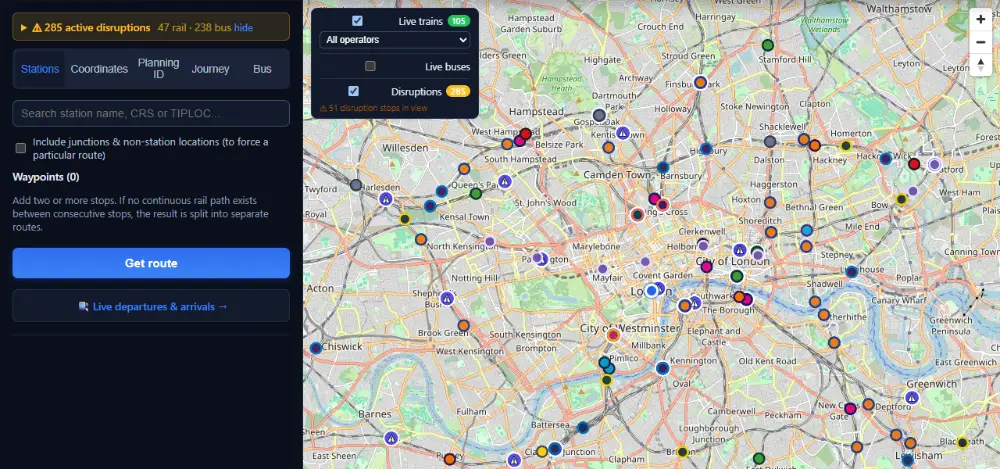 Every described train on the network, live, coloured by operator.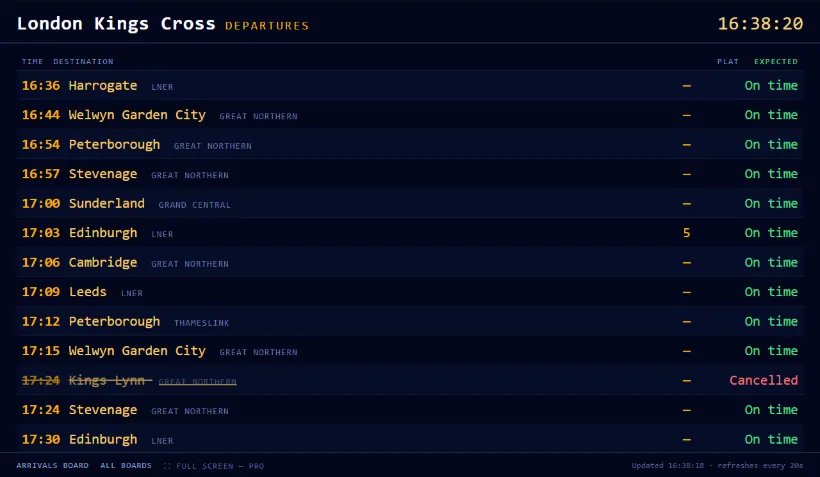
Live departure boards
Real-time departures and arrivals for any UK station — platforms, expected times, cancellations and the operator running each service.
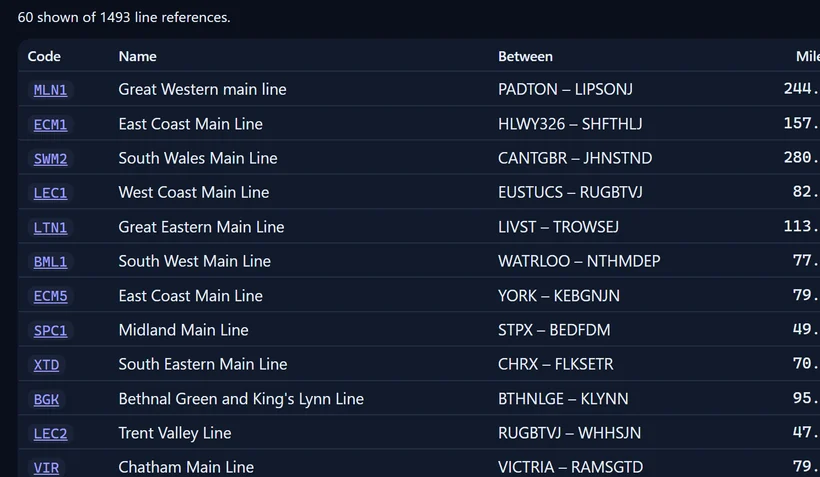
Line references
Every ELR on the network — what the code means, the line it names, where it runs from and how far.
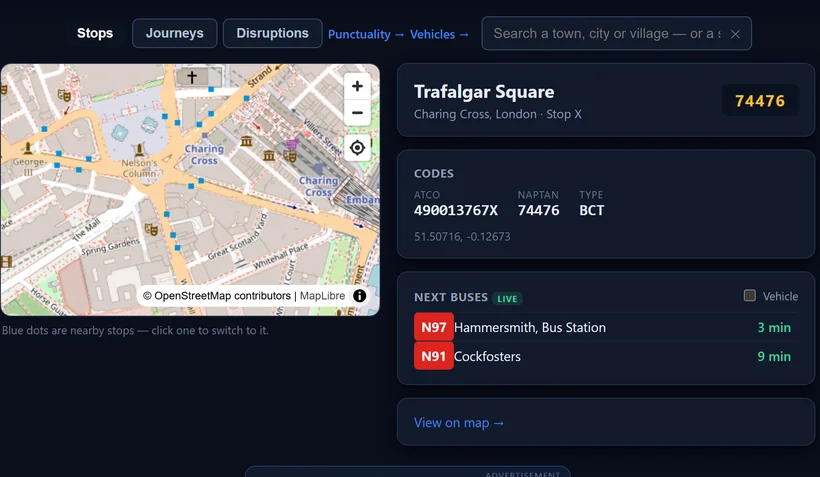
Bus stop departures
The next buses from any stop in Great Britain, live in London and timetabled everywhere else.
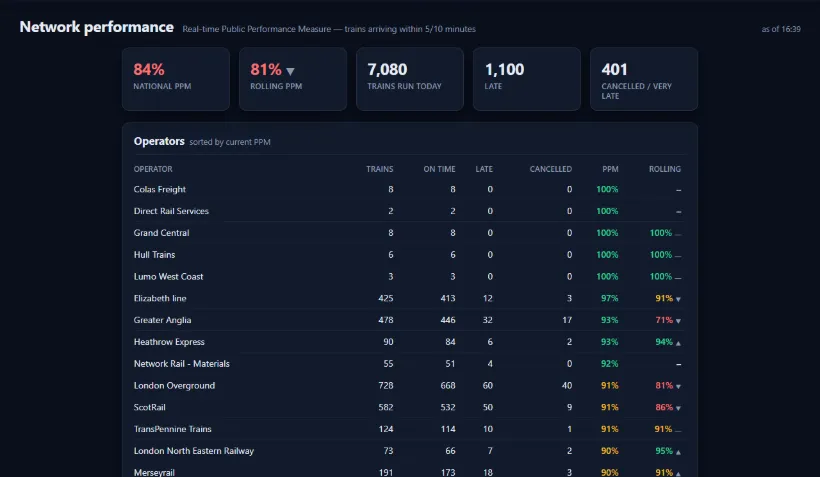
Train punctuality
Live PPM for every operator, straight from Network Rail’s RTPPM feed and updated about once a minute.
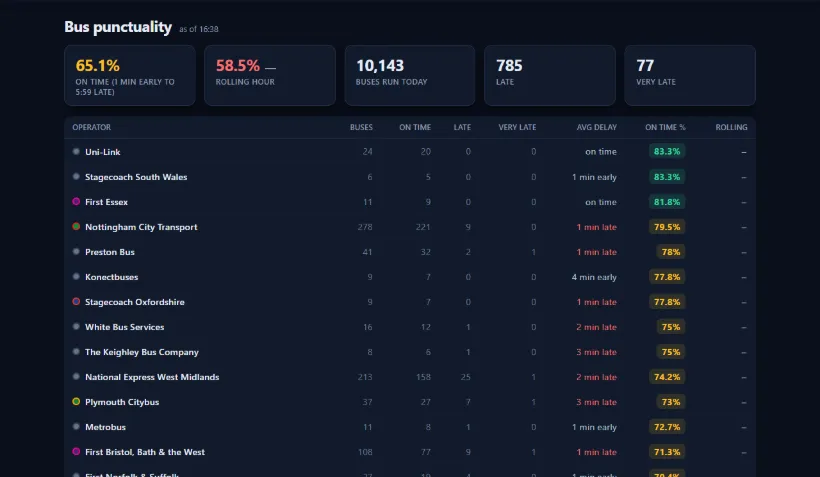
Bus punctuality
Operator on-time performance across Great Britain, measured journey by journey against the timetable.
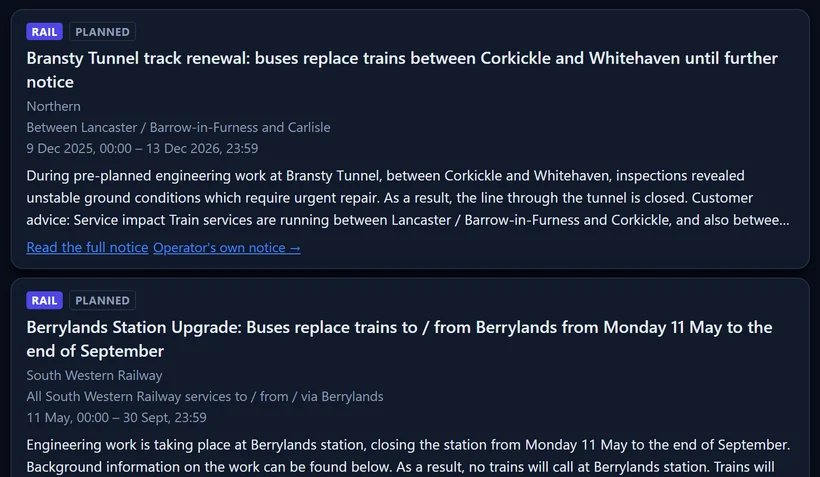
Disruptions
Incidents and engineering work across both networks in one list, filterable and mapped.
Built from the industry's own feeds
Everything here comes from the data the railway and the bus network publish about themselves — the signalling system's train describer, the forecasting engine behind station departure screens, the movement feed the network generates as trains pass timing points, and the national bus open data service. There is no scraping, no crowd-sourcing and no estimation dressed up as measurement. Every source is listed, with what each one covers and what it will not tell you.
That last part is the harder half. A feed that reports 850,000 calling points a day is not the same as one that knows where every train is, and the gap between them is where most transport sites quietly guess. We would rather show an absence: a train with no delay figure is not marked as on time, a station with no accessibility data is not marked as having none, and a position we inferred from a timetable is drawn differently from one a signal reported.
Things worth knowing about British rail data
Working with these feeds turns up a great deal that is not written down anywhere convenient. We publish what we have measured as a set of guides — every figure in them is one we took from a live feed rather than from a specification:
- Why a train on the map is never exactly where the train is — positions come from signalling berths, and roughly half of all reported movements do not move the dot at all.
- What a train is made of — which carriages form a service is published, but a cab flag does not mean a cab and a repeated allocation once turned a six-coach train into twenty-four.
- How a delay is measured — three feeds report the same late train differently, and the published punctuality figure measures something else again.
- Where the railway makes trains slow down — only a fifth of speed restrictions say when they will lift, and the oldest in force dates from 2012.
There is also a daily archive: what actually ran each day, how much of it arrived on time, and the operators' own words for why the rest did not. The live feeds keep about thirty hours of history, so anything older exists only because it was recorded as it happened.
Build with the data
The same rail and bus data is available over a JSON API — routing, boards, journeys and live maps. A free key takes a moment and gives you your own rate limit, and browsing the site needs no key at all.
Get a free API key